
POWER & BATTERY MANAGEMENT
Industrial DC-DC Converters & Auxiliary Power
OEM & CUSTOM PROJECT ENQUIRIES
Sourcing an auxiliary DC-DC converter?
Tell us the supply-voltage window, required output rails and continuous or start-up loads. VOLUXIN reviews module or enclosed converter options and project-specific configurations for equipment integration.
Request a DC-DC Configuration Quote
Configuration, sample terms and delivery are agreed for your project. Please start with non-confidential requirements.
A DC-DC converter supplies loads from a DC source with a different voltage. For industrial electrification projects, the useful starting point is the full input window, the actual output needed and the installation conditions—not only a nominal voltage or a headline power rating.
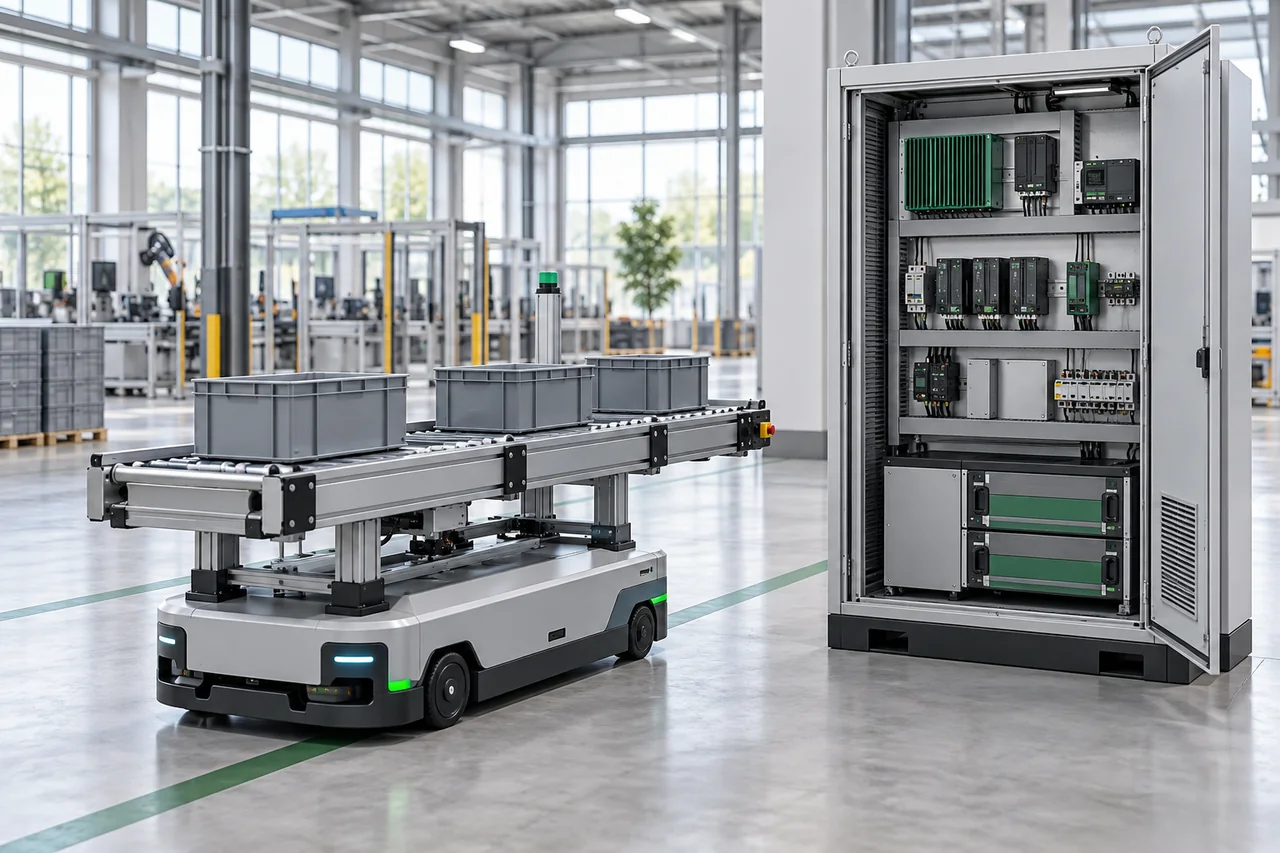
Industrial DC-DC Converters & Auxiliary Power: selection overview
An industrial DC-DC converter supplies a defined DC load from a different DC source voltage. Select it using the complete source window, actual output setpoint, load behavior and installation conditions, rather than the voltage-platform name alone.
Practical industrial electrification use cases
Use these requirement scenarios to prepare a component brief. They are engineering discussion examples, not completed VOLUXIN customer projects.
| Equipment scenario | Operating situation | What to specify |
|---|---|---|
| Automation control cabinet | A DC source feeding controllers, displays and sensors | Build a rail-by-rail load budget; confirm start-up behavior and output tolerance for each device. |
| Electrified mobile equipment | An auxiliary rail supplied from a battery or higher-voltage bus | Record discharged and charged source limits, cable length, switching events and chassis connection requirements. |
| Module integrated into an equipment assembly | Host-controlled mounting, enclosure and heat removal | Compare the module outline, fixing method and thermal interface with the host assembly before discussing rated output. |
Engineering knowledge for component selection
Use watts and amperes consistently
For a DC load, the basic steady-state relationship is power equals voltage multiplied by current. A first-pass load budget can sum the concurrently operating loads; start-up surges and transient tolerance still need separate evaluation. Rated output is subject to the final agreed operating conditions.
A converter is not a battery charger or an inverter
A DC-DC converter changes a DC voltage to another DC voltage. An inverter produces AC, and a charger controls the battery-charging process. Describe which function your system needs rather than using these product names interchangeably.
Industrial electrification power architecture and operating states
Identify whether the source is a battery pack, a regulated DC bus or another supply with a defined operating window. An industrial auxiliary power system can include control rails, contactor supplies, sensors and communications. Assign each load a voltage tolerance, current envelope and availability requirement.
Document power-up, power-down and maintenance conditions alongside normal operation. The design team should define isolation boundaries, grounding and protection coordination. Do not assume that an enclosed converter, an isolated converter and a mechanically protected module describe the same set of electrical and installation requirements.
Industrial battery management requirements: what to confirm
A BMS review is relevant when the equipment includes an electrochemical battery pack; it is not automatically needed for every DC-powered cabinet. If a battery is present, provide chemistry, series mapping, operating limits and charger behavior. Separate the battery requirements from the converter output-rail specification.
Use the BMS selection guide to organize the pack and interface questions, then compare industrial BMS catalogue references. Keep requested functions, published entries and unresolved configuration questions separate in the enquiry.
Industrial dc-dc converter: define the rail budget
For an industrial DC-DC converter, provide minimum and maximum input voltage, expected excursions, output tolerance and duty conditions. List installation temperature, cooling path and mechanical envelope. Module versus enclosed construction is a procurement decision that must account for the actual integration work required in the cabinet or machine.
Record the minimum and maximum supply values at the proposed component, not only a nominal equipment voltage. Review the DC-DC converter specification guide and DC-DC module versus enclosed converter guide before comparing catalogue construction options.
Industrial-control pcb fabrication requirements
A control or interface PCB needs a defined stack-up, mounting outline, connector positions and requested insulation geometry. Identify communication routes that require impedance control and any power copper constraints. Fabrication feasibility and circuit-performance validation are separate review tasks.
Discuss multilayer PCB manufacturing or HDI PCB fabrication with the actual stack-up, board dimensions, laminate, copper requirements, holes, surface finish and inspection notes. The custom PCB manufacturing quote checklist provides the file and procurement inputs. Bare-board fabrication is distinct from component selection, SMT assembly and finished-device testing.
Sample evaluation for industrial electrification projects
Agree a sample review plan before the order, with the equipment team responsible for defining test conditions and acceptance criteria. The scenarios below are planning examples, not completed customer projects or proof of compatibility.
| Evaluation area | Information and review task |
|---|---|
| Cabinet cold start with concurrent loads | Record auxiliary load sequencing and supply behavior under the intended start-up conditions. |
| Battery-backed control system | Define what remains powered when the main source is unavailable and whether a separate battery-management scope is needed. |
| Converter enclosure integration | Review airflow, mounting access, cable arrangement and the component temperature measurement plan. |
For each evaluation, record the sample configuration, drawing or interface revision, operating conditions and observed result. Request the available datasheet, mechanical drawing and protocol information before integration. Use the component quality and documentation review to clarify which records accompany the proposed supply.
Industrial electrification OEM quotation: scope, cost and schedule
Construction type, voltage window, isolation requirements, thermal integration and requested records affect the industrial power quotation. Compare published module and enclosed-converter options on equal electrical requirements rather than assuming that the same model label identifies an interchangeable assembly.
Ask the quotation to identify the ordering configuration, quantity, requested documents and unresolved technical points. Confirm whether mechanical, harness, protocol or PCB fabrication requests are included. Compare suppliers using the same brief; a lower price may cover a different scope, interface or evaluation requirement.
For prototype or repeat-production enquiries, state the required sample date and production schedule. Minimum order quantity, customization feasibility and lead time are confirmed individually. The custom component requirements review helps organize the discussion before a configuration is approved.
Avoid common industrial electrification selection mistakes
- Do not equate a nominal voltage label with a complete battery or converter operating range.
- Do not treat a communication connector as an agreed protocol or controller compatibility statement.
- Do not compare current or power entries without their relevant operating conditions.
- Do not infer an enclosure rating, industry certification or complete-system approval from an application photo.
- Do not assume that a bare PCB manufacturing quote includes assembled electronics or firmware.
Resolve these points in the industrial electrification component enquiry using the pack, load and installation information already available. Undecided values can be marked for review.
Further industrial electrification procurement questions
What should an OEM include in a component quote request for industrial electrification?
Identify whether the source is a battery pack, a regulated DC bus or another supply with a defined operating window. An industrial auxiliary power system can include control rails, contactor supplies, sensors and communications. Assign each load a voltage tolerance, current envelope and availability requirement. Include the evaluation quantity, expected production volume, target dates and the documents needed to approve the configuration.
Can I request a custom industrial-control PCB?
A control or interface PCB needs a defined stack-up, mounting outline, connector positions and requested insulation geometry. Identify communication routes that require impedance control and any power copper constraints. Fabrication feasibility and circuit-performance validation are separate review tasks. Provide stack-up, material, copper, hole, finish and inspection requirements for a bare-board manufacturing review.
How should industrial electrification sample evaluation be planned?
Record auxiliary load sequencing and supply behavior under the intended start-up conditions. Agree operating conditions and acceptance criteria with the equipment designer. Record the sample configuration and requested datasheet or protocol revision; component supply does not establish complete-system approval.
What affects industrial electrification component cost and lead time?
Construction type, voltage window, isolation requirements, thermal integration and requested records affect the industrial power quotation. Compare published module and enclosed-converter options on equal electrical requirements rather than assuming that the same model label identifies an interchangeable assembly. MOQ, customization feasibility and delivery timing are confirmed in the quotation for the agreed scope.
How do I specify industrial DC-DC converter?
For an industrial DC-DC converter, provide minimum and maximum input voltage, expected excursions, output tolerance and duty conditions. List installation temperature, cooling path and mechanical envelope. Module versus enclosed construction is a procurement decision that must account for the actual integration work required in the cabinet or machine.
What documents are useful before industrial electrification integration?
Request the configuration-specific datasheet, mounting and interface drawing, and communication information where applicable. Define the sample acceptance plan with the equipment designer and confirm which documents are available before an order is approved.
Does industrial electrification PCB fabrication include assembled control electronics?
No. A bare-board quotation covers the agreed PCB fabrication scope. Component sourcing, SMT assembly, firmware and finished-board functional testing need a separate scope review; these pages do not promise turnkey control-electronics supply.
Prepare your OEM component enquiry
Equipment manufacturers, battery-pack integrators and procurement teams can use this checklist to separate known design inputs from questions that still need confirmation.
- Source minimum/maximum and separately recorded transient conditions
- Each output setpoint and allowable voltage variation
- Concurrent load budget, start-up peaks and duration
- Mounting, ambient temperature and heat-removal arrangement
- Required isolation, environmental or EMC evidence for the configuration
Include project stage, evaluation quantity, expected order volume and requested delivery timing. Request the configuration-specific datasheet, mechanical drawing and interface information, then agree sample acceptance criteria. Available customisation and document scope are confirmed for the proposed configuration.
OEM selection questions
How do I choose an industrial DC-DC converter input range?
Document the lowest and highest steady-state source voltages over the operating cycle, then identify transients separately. Compare those values with the selected catalogue option; a 350V or 800V platform label is not a complete input specification.
Should I choose a DC-DC module or an enclosed converter?
Choose around integration constraints: host enclosure, mounting, cooling path, wiring and service access. Review the actual outline and connection documentation. Construction alone does not establish isolation, ingress protection or continuous output capability.
Related application guides
- Off-Highway BMS & DC-DC for Construction and Agriculture
- AGV & AMR BMS and DC-DC Power Supply Solutions
Industry background: ST DC-DC converter application overview. External guidance explains component roles; VOLUXIN ordering specifications and compatibility require separate confirmation.
Catalogue platforms at a glance
| Input platform | Published input range | Example series |
|---|---|---|
| 72V | 50–100V | 72V enclosed converters |
| 96V | 64–128V | 96V enclosed converters |
| 144V | 90–200V | 144V modules |
| 350V | 200–450V | 350V enclosed converters |
| 540V | 400–750V | 540V modules |
| 800V | 500–950V for listed main options; 51V enclosed option is 400–750V | 800V converter options |
These are catalogue windows, not a qualification for transient immunity or every load condition. The 800V family name must not override the different input range of its 51V option.
Define the auxiliary loads
Group loads by required output voltage. For each group, record running current, start-up demand, simultaneous operation and any interruption tolerance. Include controls, lighting and accessories that are actually present in your project. A system sketch is useful for distinguishing the main power path from auxiliary power.
Choose the construction around the installation
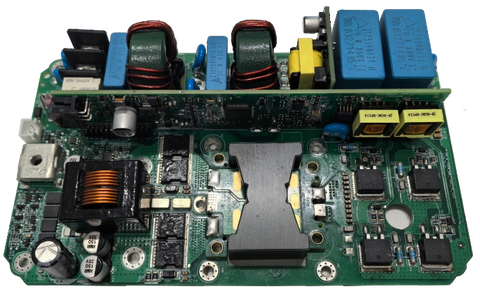
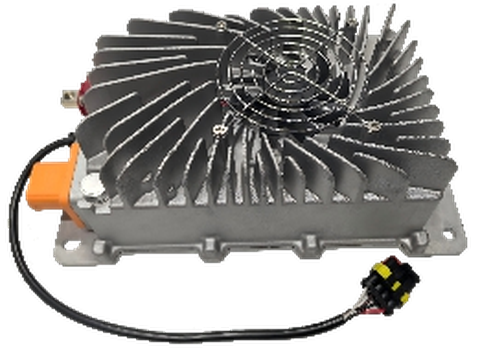
Modules and enclosed converters are separate catalogue constructions. A module review needs to identify the host mounting and thermal arrangement. An enclosed converter review needs to confirm its envelope, mounting and connections. Neither the product name nor the image establishes an IP rating, isolation specification or cooling capacity.
Read DC-DC module versus enclosed converter before selecting a construction. Review DC-DC modules and converters for the exact platform options.
Prepare a configuration review
- Record minimum and maximum steady-state input and identify transients separately.
- Give each load’s actual output requirement and permitted tolerance.
- Separate continuous operation, start-up and intermittent demand.
- Specify mounting, cooling, environmental and isolation requirements.
- Identify wake/control needs and the documentation required for integration.
Common questions
Does the rated kW figure establish continuous power?
Not by itself. The catalogue values need to be reviewed with temperature, cooling, derating and duty conditions for the selected configuration.
Does an enclosed converter automatically provide a particular IP rating?
No enclosure protection rating is established by the catalogue construction label. Request configuration-specific evidence if a rating is required.
Can an existing catalogue model label define the order?
Some labels appear in multiple voltage or construction ranges. Include the input platform, output, construction and control option; confirm the complete ordering configuration.
Use the DC-DC selection guide and the product supply and customisation process to move from a system requirement to a product discussion.
Download the requirements worksheet (CSV)
Published by VOLUXIN · Updated 1 October 2026.
CUSTOM PCB FABRICATION
PCB manufacturing for your electronics project
For equipment-specific control, sensing or interface boards, discuss multilayer or HDI PCB fabrication using your design data. Board manufacture and BMS or DC-DC component selection are separate scopes; system performance must be validated in the equipment.
Explore PCB manufacturing → Discuss PCB requirements →VOLUXIN ENGINEERING REFERENCES
Compare products and prepare your technical brief
Read catalogue comparison tables and procurement worksheets online, or download an editable CSV. Reference tables reproduce published entries; worksheets are blank review aids, not test results or final engineering specifications.
| Reference | Purpose |
|---|---|
| DC-DC configuration reference | Platform, construction and exact model/output rows; repeated labels remain attached to their range. |
| DC-DC load review worksheet | Source window, auxiliary loads, cooling and evaluation conditions. |
VOLUXIN editorial references · Worksheets updated 5 October 2026; catalogue reference tables dated 2 October 2026. BMS/DC-DC values are based on supplied product catalogues; PCB entries use the 2026 fabrication reference. Request configuration-specific drawings, protocols and evaluation records for the quoted scope.
Tell us what your equipment needs.
Share your application, product requirements and any details you have already confirmed. We can then discuss the available options.
Discuss Your Requirements